Bridges by Rail

Lucas Schneider
| 08-07-2026
 · Travel team
Some rail journeys are remembered not because of the destination, but because of a single unforgettable crossing.
As a train rolls onto a bridge suspended above rivers, valleys, or the sea, the view changes in seconds from enclosed landscapes to sweeping panoramas.
These moments are brief, which is why planning ahead matters. Choosing the right route, the right seat, and the right departure time can transform a simple train ride into one of the most memorable experiences of an entire trip.
Choose the Right Railway and Travel at the Best Time
Not every scenic railway delivers the same experience. Some bridges are crossed in only a few seconds, while others form part of a much longer panoramic journey.
For travelers visiting Europe, two routes consistently stand out.
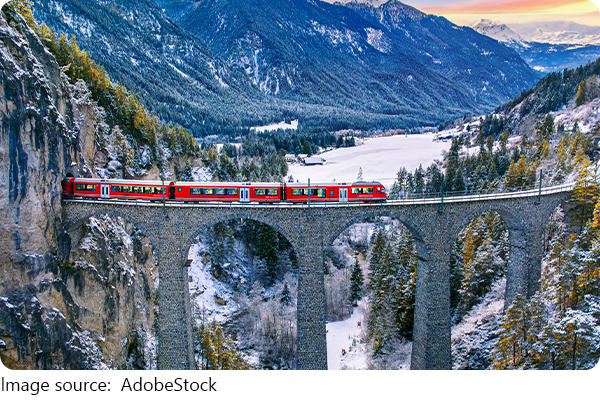
Glacier Express and the Landwasser Viaduct
The Glacier Express connects Zermatt and St. Moritz, covering about 291 km in roughly 8 hours.
One of its highlights is the Landwasser Viaduct, a six-arched limestone bridge standing approximately 65 meters above the valley floor before disappearing directly into a tunnel carved into the cliff.
Bernina Railway
The UNESCO-listed Bernina Railway links St. Moritz with Tirano, climbing to 2,253 meters at Ospizio Bernina while crossing numerous dramatic bridges and stone viaducts along the way.
Both routes operate throughout the year, but each season offers a different atmosphere.
Late May through early July brings green valleys, waterfalls fed by melting snow, and comfortable temperatures.
September and early October combine crisp air, golden forests, and excellent visibility, making them favorite months for photographers.
Winter offers spectacular snow-covered scenery, although daylight is shorter and some mountain views may be hidden by snowfall.
Reservations are strongly recommended.
Typical fares include:
• Glacier Express: approximately CHF 150–250, depending on class and route, plus a mandatory seat reservation.
• Bernina Express: ticket prices vary by distance, generally CHF 35–80, with a separate reservation fee for panoramic coaches.
Regional trains covering the same railway lines are often less expensive and provide more flexibility for travelers who prefer to stop along the route.
Choose departures between 9:00 and 11:00 whenever possible. Morning light usually provides clearer mountain views, while avoiding the earliest commuter services.
Window seats are essential.
When booking, check which side of the train offers the best bridge views for your direction of travel, as this differs between routes.
As the train gradually climbs through forests and mountain villages, anticipation builds long before reaching the bridge itself. Suddenly the valley opens, the tracks leave solid ground, and the train seems to float effortlessly above rivers, cliffs, and deep gorges.
Bernina Express
Make the Bridge Crossing Part of the Experience
Many passengers miss the best moment simply because they are unprepared.
Know When the Crossing Happens
The most famous bridges usually appear well into the journey rather than immediately after departure.
Download the route map beforehand or ask the onboard staff approximately when the train will reach the bridge. This gives you enough time to prepare your camera and enjoy the scenery instead of reacting at the last second.
Move Carefully Between Carriages
If your train allows movement, avoid waiting until the bridge is directly ahead.
Return to your seat several minutes before the crossing. Standing in aisles or blocking windows often disturbs other passengers and rarely improves the view.
Look Beyond the Bridge
The bridge itself lasts only moments.
What makes these crossings unforgettable is the surrounding landscape.
Mountain rivers winding through deep valleys, waterfalls cascading down cliffs, traditional villages tucked beneath towering peaks, and forests stretching toward distant glaciers all contribute to the experience. Spend as much time watching the scenery before and after the bridge as the crossing itself.
Bring Food for Longer Journeys
Some panoramic trains provide restaurant service, while regional trains may only offer light refreshments or vending machines.
Packing water and simple snacks is always useful, especially on journeys lasting more than four hours.
If dining onboard, expect meals to cost approximately CHF 20–40 per person, depending on the route and menu.
Dress for Changing Conditions
Even though you remain inside the train, many scenic routes include planned stops where passengers can briefly leave the platform.
A lightweight jacket, sunglasses, and comfortable walking shoes allow you to enjoy these stops without rushing.
Avoid Common Mistakes
Do not choose an evening departure simply because it is cheaper. Reduced daylight often means missing the finest scenery entirely.
Avoid sitting beside large luggage if possible. Overhead racks and designated luggage areas provide much more comfortable viewing.
Finally, resist spending the entire crossing looking through a camera screen. Taking a few photographs is worthwhile, but watching the train glide across the bridge with your own eyes is often the memory that lasts longest.
A realistic budget for a scenic railway day, including tickets, reservations, meals, refreshments, and local transportation, generally ranges between CHF 80 and CHF 300 per person, depending on the route, travel class, and booking time.
A train crossing a bridge is much more than a brief engineering achievement. It represents the moment when railway design and spectacular landscapes come together to create one unforgettable journey. By choosing the right route, reserving a window seat, traveling during the best season, and preparing for the crossing in advance, you will experience far more than a simple train ride.