Safe Overtaking Tips

Santosh Jha
| 30-04-2026
 · Automobile team
When we drive on busy roads, passing other vehicles can feel like a quick decision, but it actually requires calm judgment and clear awareness.
A small mistake during a pass can lead to unexpected situations, especially on highways or narrow lanes.
That is why we are sharing a simple, practical guide to help drivers handle these moments more safely and confidently. Let’s go through each point step by step in a clear and easy way.
1. Observe from far, then check closely before passing large vehicles
When we are behind a large truck, we first observe its overall condition from a distance. We check if the cargo seems stable, if doors are properly closed, and if anything might fall. As we get closer, we focus on its driving line. If the truck stays steady in the middle of the lane, it is safer. But if it drifts toward lane markings, we should hold back from passing.
We also avoid situations where three vehicles line up closely in the same lane. This setup reduces reaction space and increases risk if any vehicle suddenly changes direction.
2. Confirm road and traffic conditions before making a move
Before deciding to pass, we quickly scan three things. First, the road ahead should be clear without hidden obstacles or unexpected pedestrians. Second, the vehicle in front should be moving steadily without signs of slowing or shifting lanes. Third, we check the rear area to ensure no faster vehicle is approaching quickly.
Only when these conditions feel stable do we proceed with the maneuver.
3. Respect turn signals from the vehicle ahead
If the vehicle in front signals a left movement, we pause immediately. This signal may mean the driver plans to shift lanes or avoid something ahead. It could also be a warning about conditions we have not noticed yet.
Instead of guessing, we wait and observe. This short delay helps prevent misunderstandings and reduces unnecessary risk.
4. Avoid copying heavy vehicle driving habits
Large trucks sometimes move closer to the vehicle ahead before passing because they need more space to gain speed. However, this is not a suitable method for smaller vehicles.
If we follow too closely, our view of the road ahead becomes limited. We may miss obstacles or sudden changes. Keeping a safe distance improves awareness and provides more reaction time.
5. Be careful when two vehicles ahead are moving closely together
When we see two vehicles traveling tightly in front, especially with the rear one braking often, we slow down our decision-making. The rear vehicle might change lanes at any moment.
In such cases, we keep distance, observe calmly, and use light signaling to communicate intentions before acting.
6. Complete the pass smoothly and maintain safe spacing
During a passing action, smooth acceleration helps reduce time spent in the opposite lane. Once we finish, we do not return immediately. We wait until we can clearly see the full front of the passed vehicle in our mirror.
We also avoid returning too soon if there is congestion ahead, because merging early may reduce safe space and create unnecessary pressure for vehicles behind.
7. Do not follow another vehicle’s passing action blindly
If another driver starts to pass, we should not rush to follow right away. Conditions may change quickly. Once the lead vehicle returns to its lane, unexpected obstacles or oncoming traffic may appear.
Waiting a moment allows us to understand the road situation better.
8. Pay attention when nearby vehicles slow down
If we notice brake lights from vehicles in front or in nearby lanes, we avoid passing at that moment. Slowing often means the driver is responding to something ahead, such as traffic changes or pedestrians crossing.
Passing during this time may place us in an unpredictable and dangerous situation.
9. Stay cautious at intersections and crossing areas
At junctions, we avoid passing vehicles traveling side by side in the same direction. These areas often have limited visibility, and unexpected movement can happen quickly.
It is safer to move through the intersection first, then decide if passing is necessary once the road becomes clearer.
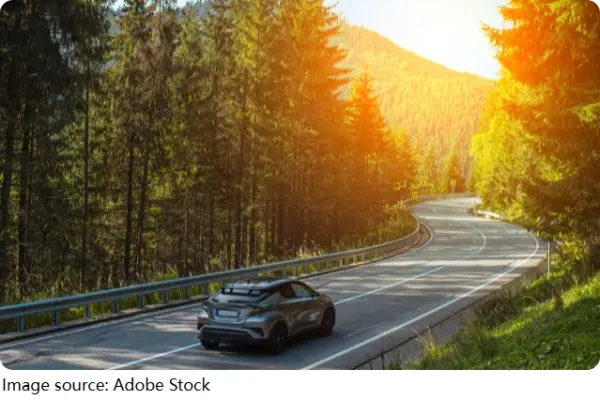
10. Avoid passing in curves, junctions, and hilltops
Curves, intersections, and hilltop areas all share one issue: limited visibility. We cannot clearly see what is ahead. Because of this, these spots carry higher uncertainty.
Instead of taking risks in these areas, we wait until the road straightens and visibility improves before making any decision.
Drive with Awareness
Lykkers, safe passing is not about speed alone, but about timing, observation, and patience. When we stay alert to road conditions and respect space around other vehicles, we create a smoother and safer driving experience for everyone.
Next time we are on the road, let’s take a few extra seconds to observe before making any move. Those seconds often make all the difference.